A turd that needs to be flushed or polished…
The earliest recollections were two-fold. At the age of 7, or thereabouts, while in primary school, I was asked to draw and colour in a picture of a Jersey cow. To this day I can recall the rapture I felt in attempting to capture the colour and textures. The second intense memory was the floor of a wood in Switzerland, following a heavy rain shower. The water lay on the grassy surface with the sunlight penetrating the branches of the pines, illumining the puddles with a rainbow of colours.
This was followed by some lean years of producing fighting stickmen until there was a growing desire to reproduce what I could see. But it was some years later, as a teenager that I was taught by my much-admired art teacher, Mr. Allen, a particularly fine draughtsman, who explained that seeing and drawing should be like a blind man feeling the subject with one’s fingertips. Without doubt, these were the years when I fell under the spell of Rembrandt, my love for Northern European Renaissance masters, and Salvador Dali.
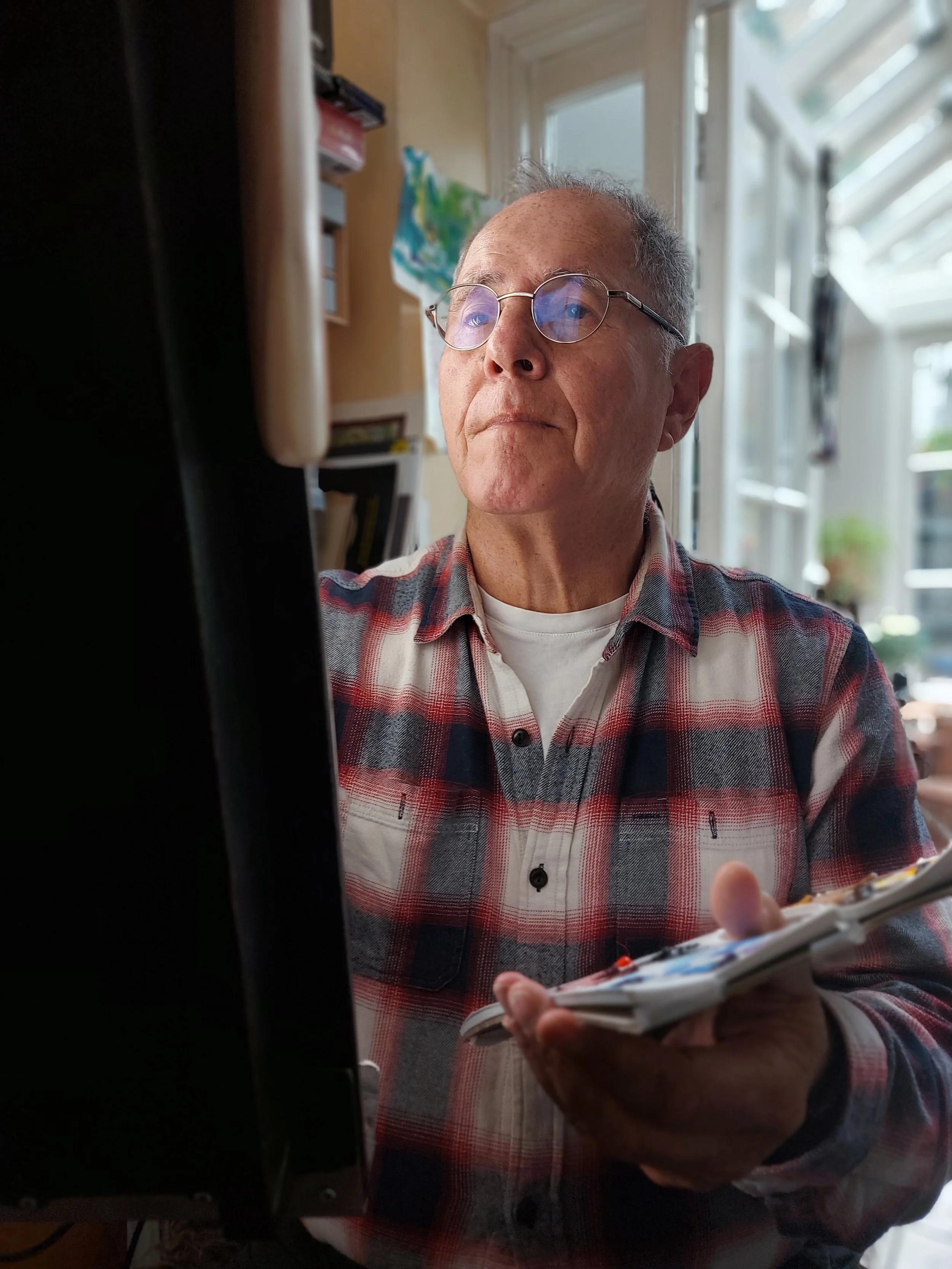
During the years, struggling to study art history, I fell under the spell of the different methods and techniques of the Photorealists, the vision of Pop art, and the psychedelic artists. It was at this time that I came under the influence of Roy Bradley, the chief conservator of the Brighton Pavilion. He was a master of many skills and crafts. It was he who impressed me to take up painting conservation. Thus followed my training under several teachers including Helmut Ruhemann, consultant restorer to the National gallery, London. Some years after, I was asked to establish a conservation studio for Sotheby’s through its subsidiary, James Bourlet, the famous traditional fine framers. Through the support of Peter Nahum, I had the privilege to specialize in the restoration of Pre-Raphaelite paintings. Through Sotheby’s I was asked to work on the technically problematic 18th and 19th Century Iranian Qajar paintings. It was at this time that I had the honour of studying and working with the world-renowned microscopist, Walter McCrone.
In 1979 my wife, and daughter settled in Israel, where I lectured in the history of painting techniques, and art materials at Bezalel school of art, the Hebrew University, and worked as an art therapist at Givat Shaul mental hospital. It was during this period that I consolidated my need to respond to my family history and their deaths in the Holocaust. It was a struggle to decide which visual language to use to memorialise the terrible destruction of a people, culture, and history. I attempted to combine those schools of painting that most represented meaning. The choice of recreating a realism of the Norther European Renaissance was an ironic use of the style of religious devotional art. Reflecting on the dark vision of Hieronymus Bosch, or Goya’s ‘Los disastres de la guerra’. Pop Art has been used to represent all things, amongst other sources, particularly the inclusion of photographs. As far as I know, pop art has not represented the darker aspect of history, with the exception of Lichtenstein’s representation of fighter planes.
Of course, the subject that proves my obsessive character the most, is my repeated need to paint mountains. There is the combination of the relentless rocks, the ghostly snows, and the veil-like clouds that can come and go, revealing and concealing mother earth.
A turd that needs to be flushed or polished…
The earliest recollections were two-fold. At the age of 7, or thereabouts, while in primary school, I was asked to draw and colour in a picture of a Jersey cow. To this day I can recall the rapture I felt in attempting to capture the colour and textures. The second intense memory was the floor of a wood in Switzerland, following a heavy rain shower. The water lay on the grassy surface with the sunlight penetrating the branches of the pines, illumining the puddles with a rainbow of colours.
This was followed by some lean years of producing fighting stickmen until there was a growing desire to reproduce what I could see. But it was some years later, as a teenager that I was taught by my much-admired art teacher, Mr. Allen, a particularly fine draughtsman, who explained that seeing and drawing should be like a blind man feeling the subject with one’s fingertips. Without doubt, these were the years when I fell under the spell of Rembrandt, my love for Northern European Renaissance masters, and Salvador Dali.
Contact
email@example.com
(555) 555-555
During the years, struggling to study art history, I fell under the spell of the different methods and techniques of the Photorealists, the vision of Pop art, and the psychedelic artists. It was at this time that I came under the influence of Roy Bradley, the chief conservator of the Brighton Pavilion. He was a master of many skills and crafts. It was he who impressed me to take up painting conservation. Thus followed my training under several teachers including Helmut Ruhemann, consultant restorer to the National gallery, London. Some years after, I was asked to establish a conservation studio for Sotheby’s through its subsidiary, James Bourlet, the famous traditional fine framers. Through the support of Peter Nahum, I had the privilege to specialize in the restoration of Pre-Raphaelite paintings. Through Sotheby’s I was asked to work on the technically problematic 18th and 19th Century Iranian Qajar paintings. It was at this time that I had the honour of studying and working with the world-renowned microscopist, Walter McCrone.
In 1979 my wife, and daughter settled in Israel, where I lectured in the history of painting techniques, and art materials at Bezalel school of art, the Hebrew University, and worked as an art therapist at Givat Shaul mental hospital. It was during this period that I consolidated my need to respond to my family history and their deaths in the Holocaust. It was a struggle to decide which visual language to use to memorialise the terrible destruction of a people, culture, and history. I attempted to combine those schools of painting that most represented meaning. The choice of recreating a realism of the Norther European Renaissance was an ironic use of the style of religious devotional art. Reflecting on the dark vision of Hieronymus Bosch, or Goya’s ‘Los disastres de la guerra’. Pop Art has been used to represent all things, amongst other sources, particularly the inclusion of photographs. As far as I know, pop art has not represented the darker aspect of history, with the exception of Lichtenstein’s representation of fighter planes.
Of course, the subject that proves my obsessive character the most, is my repeated need to paint mountains. There is the combination of the relentless rocks, the ghostly snows, and the veil-like clouds that can come and go, revealing and concealing mother earth.